Most people think of neck exercises as stretches, head rotations, or perhaps a few chin tucks. Joseph Pilates approached the neck differently. Among his lesser-known pieces of equipment is the Neck Stretcher, a deceptively simple apparatus that uses spring resistance, and eventually the challenge of body weight, to strengthen the muscles responsible for controlling the head, and their connections down the body into the torso and beyond.
Despite its name, the Neck Stretcher is not simply a device for lengthening tight muscles. It provides an opportunity to explore how the neck generates force, responds to resistance, and coordinates with the rest of the body. Understanding its value requires looking beyond the neck itself to consider how forces are transmitted through the cervical spine and into the torso.
The Deep Muscles That Support Your Head
The cervical spine contains seven vertebrae that allow the head to turn, tilt, and nod while protecting the spinal cord. Surrounding these vertebrae is a complex arrangement of muscles, organized in layers, with different mechanical responsibilities. Larger, more superficial muscles, such as the sternocleidomastoid and upper trapezius, contribute to moving and supporting the head. Deeper muscles, including the longus colli and longus capitis, help control the relationship between the skull and cervical vertebrae.
The upper cervical spine is particularly interesting because its first two vertebrae have specialized structures that allow the head to move with remarkable precision. The first cervical vertebra, called the atlas (C1), supports the skull and forms a joint that allows the subtle nodding motion we associate with saying “yes.” The second vertebra, called the axis (C2), has a distinctive bony projection around which the atlas rotates, allowing us to turn our heads from side to side. This joint accounts for a substantial proportion of the neck's rotational range.
The remaining cervical vertebrae contribute to flexion, extension, rotation, and side bending, with movement distributed across multiple joints. Rather than operating as independent hinges, these vertebrae work together through coordinated muscular activity, allowing us to orient our head, stabilize our gaze, and respond continuously to movement throughout the body.
The deep cervical muscles help regulate subtle adjustments without requiring large movements. When you gently nod your head or maintain its position against light resistance, several layers of muscles must coordinate their activity. Effective neck control depends not on isolating one muscle perfectly, but on developing cooperation among these different muscular layers. Much like individual musical notes arranged into a melody, the quality of movement depends on the timing, sequence, and relationship between each contribution.
The Neck's Connection to the Deep Anterior Line
In Thomas Myers' Anatomy Trains model, the Deep Front Line, also called the Deep Anterior Line, describes a series of anatomical relationships extending from the inner foot and leg through the pelvis, deep trunk muscles, diaphragm, and neck. The deep cervical muscles mentioned above are part of this conceptual pathway. Their relationship with the thoracic spine, rib cage, and diaphragm helps illustrate why the position and movement of the head cannot be understood entirely in isolation. Joe understood this and used resistance exercises to teach these concepts to his clients.
Consider what happens when you attempt to stabilize your head while holding your breath. Increased bracing through the chest and abdomen can change the muscular effort required throughout the trunk and neck. Allowing the ribs to move with breathing while maintaining gentle cervical control creates a different coordination challenge.
The Deep Anterior Line offers a useful framework for exploring these relationships, although it should not be interpreted as a single continuous cord transmitting tension directly from the feet to the skull. The interaction between the neck and the rest of the body becomes particularly apparent when using one of Joseph Pilates' lesser-known pieces of equipment: the Neck Stretcher.
Why Joseph Pilates Used Resistance
Joseph Pilates developed specialized apparatus to help people explore movement through springs, straps, and other forms of resistance. His Neck Stretcher applies this principle to an area that is often addressed primarily through stretching.
Pilates was not the first person to explore neck training against resistance. His contribution was incorporating this type of work into his broader system of movement, originally called Contrology, where strength, coordination, and whole-body integration are fundamental principles. The neck is not special or separate; its an extension of the spine to be trained with the same level of precision and rigor as the rest of the body.
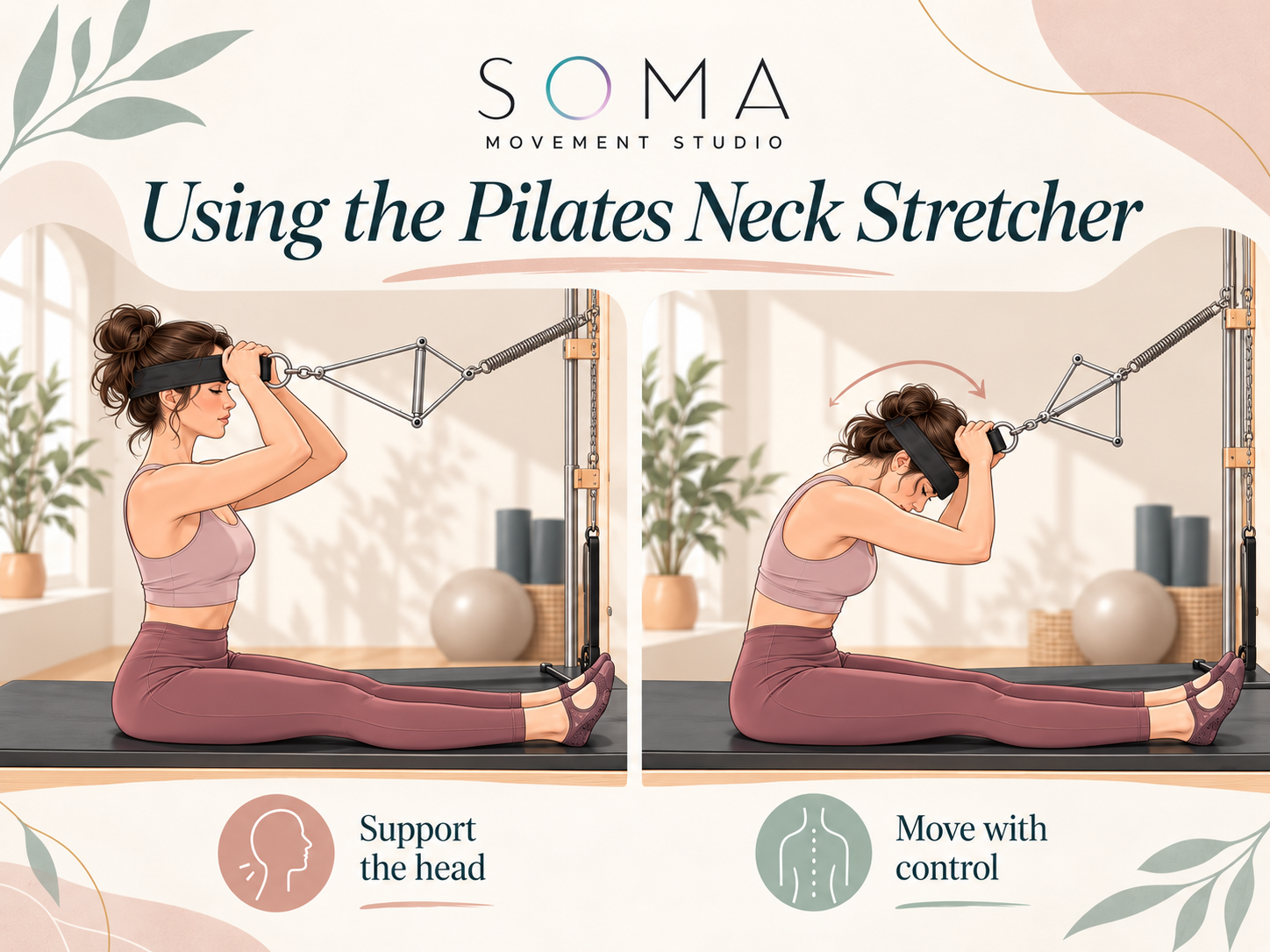
The Neck Stretcher uses a head harness connected to a spring that provides resistance as the participant moves or stabilizes the head. The changing direction and amount of resistance challenge the neck muscles to respond while maintaining coordination with the torso. The apparatus can develop strength and endurance, but its educational value extends beyond muscular effort. Participants must recognize how the head moves relative to the torso, maintain comfortable breathing, and coordinate the neck with the shoulders and trunk. Stress the neck without developing strain anywhere else in the body.
As control improves, the exercise can progress beyond maintaining an upright position. With the Neck Stretcher attached, the participant gradually leans the entire body away from the spring's attachment point, potentially reaching an angle of approximately 45 degrees. Rather than bending at the neck or waist, the challenge is to maintain coordinated alignment from head to feet while the spring provides resistance.
This progression introduces a greater demand on whole-body stability. The neck must remain coordinated with the trunk as the participant manages the combined effects of spring resistance, gravity, and the body's changing position. What begins as a relatively small neck exercise becomes an integrated challenge involving the entire body. The objective is not to overpower the spring or achieve the greatest possible angle, but to develop the ability to respond to resistance with appropriate control.
From Awareness to Whole-Body Integration
At SOMA, we don't begin by placing someone directly into a demanding Neck Stretcher exercise. We first develop awareness of cervical alignment, muscular engagement, and controlled resistance through preparatory exercises. In our previous article, Why Your Neck Feels Tired: When Strengthening May Help More Than Stretching, we explored how gentle isometric exercises using soft balls can help develop neck strength, endurance, and coordination.
Once participants can recognize and regulate these muscular relationships, the Neck Stretcher introduces a new challenge. Spring resistance requires the neck to maintain its relationship with the torso while the body responds to changing external forces. As the exercises become more demanding, the participant must coordinate the neck, spine, trunk, and lower body rather than relying on isolated muscular effort.
This progression from awareness to controlled resistance and eventually whole-body integration reflects a fundamental principle of Pilates: developing the ability to organize movement efficiently as its complexity increases.
A Different Way to Think About Neck Posture
Good neck function is not about holding the head in one supposedly perfect position. Our heads are designed to move, continually making small adjustments to maintain balance, orient our senses, and keep our gaze steady as the body changes position. This coordination can appear almost gyroscopic in its precision. A more useful objective is to develop the muscular capacity and coordination to move through these positions comfortably, without relying on excessive tension.
Joseph Pilates' Neck Stretcher provides an interesting example of this philosophy. Rather than treating the neck as a collection of muscles that simply need to be stretched, it encourages us to consider how strength, endurance, breathing, and whole-body coordination work together.
Our upcoming Head & Neck Posture: More Than a Neck Stretch workshop will explore these principles, progressing from preparatory exercises to guided work with the Pilates Neck Stretcher.
Participants will have the opportunity to experience how subtle changes in muscular coordination can influence the way the head and neck respond to resistance.
Learn more about the Head & Neck Posture workshop →
SOMA Movement Studio | Unionville, Connecticut