The surprising science of muscle fatigue, motor control, and the nervous system
You're halfway through a Pilates class, holding your legs in tabletop or slowly pressing the Reformer carriage away from the footbar, when something unexpected happens. Your legs begin to shake. Perhaps it's a subtle vibration in your thighs or a more dramatic trembling that makes you wonder whether you'll finish the exercise. You haven't necessarily reached exhaustion, and the movement itself may not look particularly difficult. So why is your body behaving as though it's working so hard?
The answer lies in the remarkable complexity of neuromuscular coordination. Pilates challenges muscles not only to produce force, but to regulate that force with precision, often in unfamiliar positions. Shaking can be one visible expression of that effort.
Your Muscles Are Never Completely Still
Every voluntary muscle contraction is controlled by motor units, each consisting of a motor neuron and the muscle fibers it activates. Individual muscle fibers respond to electrical impulses according to an all-or-none principle, binary, on/off, but the force produced by an entire muscle is remarkably adaptable. Your nervous system regulates force by recruiting additional motor units and adjusting how frequently they fire.
Think of an LED light that appears continuously illuminated even though its light may be pulsing rapidly. Similarly, muscle fibers receive repeated electrical signals that produce what we perceive as a sustained contraction. Even during a seemingly motionless hold, however, muscular force fluctuates as your nervous system makes continuous adjustments.
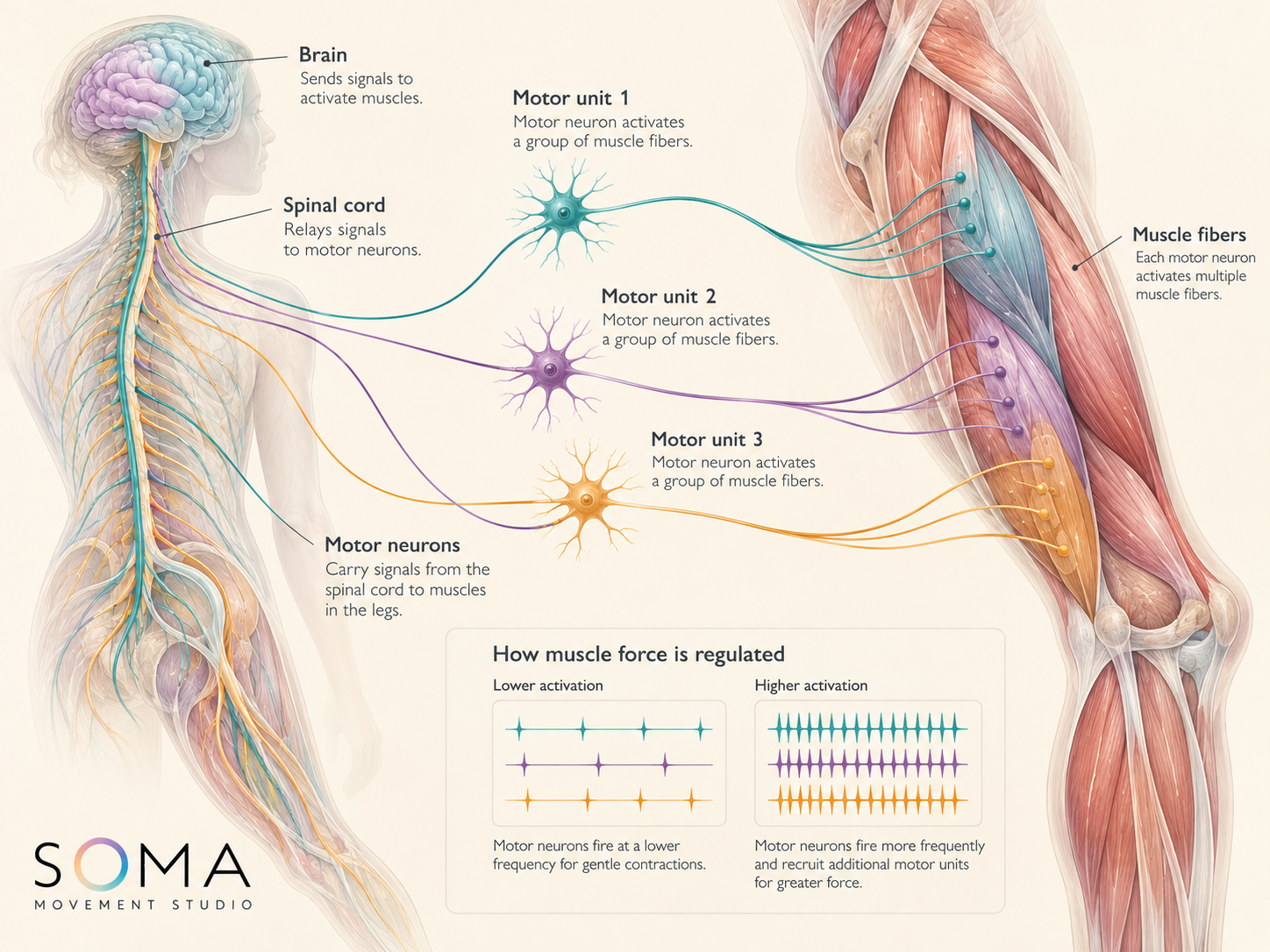
These fluctuations are usually too small to notice. When an exercise becomes demanding, changes in motor-unit firing, muscular fatigue, and mechanical feedback can make them more apparent. The resulting trembling is not necessarily evidence of exhausted muscles; it may reflect the difficulty of coordinating force under unfamiliar conditions.
Why the Reformer Can Make Your Legs Tremble
The Pilates Reformer introduces an unusual combination of resistance, movement, and external guidance. Spring tension changes as the carriage travels, while the shoulder rests and footbar influence how the body organizes itself. Someone who habitually shifts weight toward one hip while standing may discover a different challenge when the apparatus encourages a more symmetrical position.
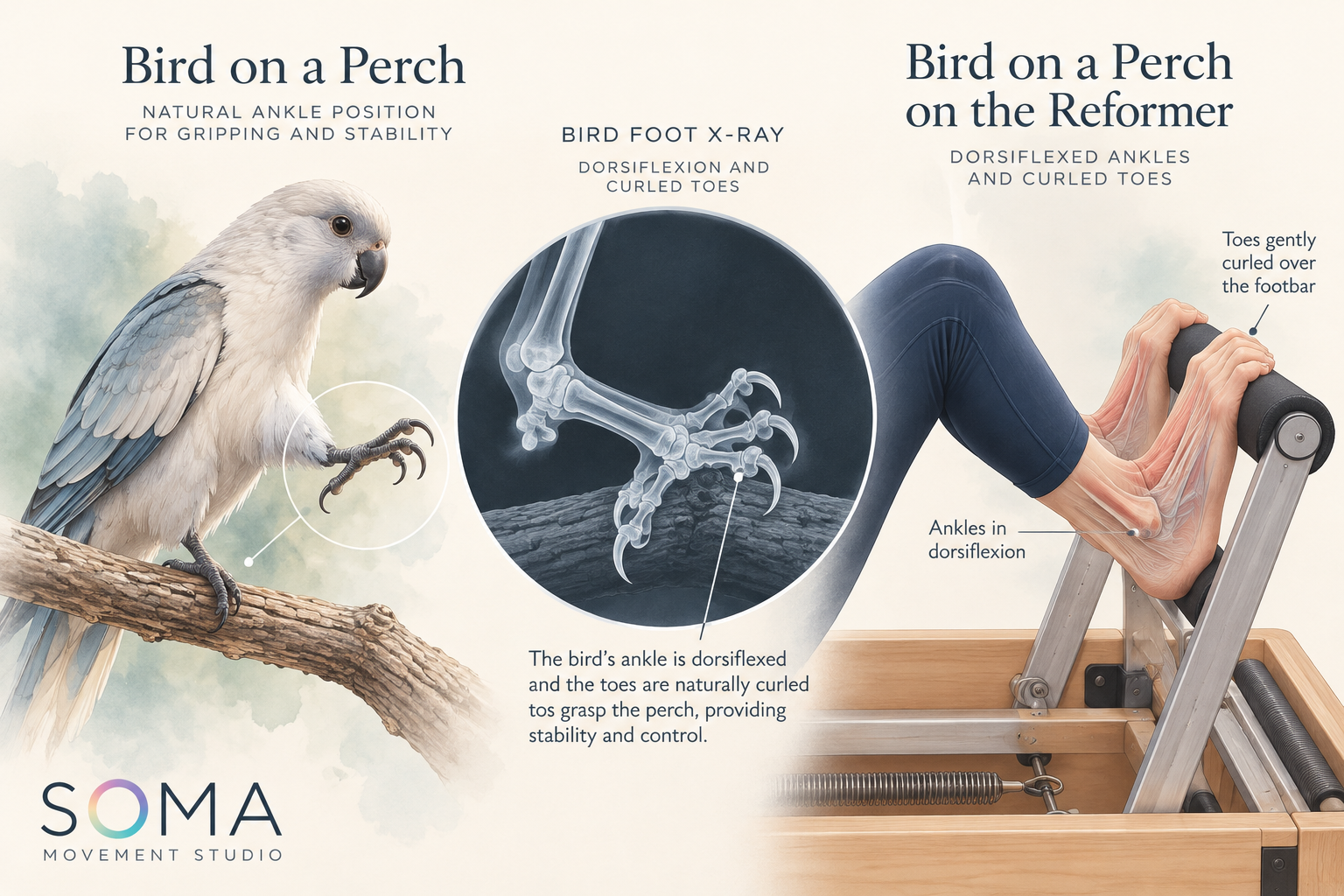
Consider Bird on a Perch, a traditional Reformer footwork position. The ankles are held in dorsiflexion while the legs control the carriage against spring resistance. Many people spend much of their day in shoes with elevated heels or with limited opportunities to explore sustained ankle dorsiflexion. The unfamiliar position, combined with muscular effort and the need for precise control, may provoke trembling.
Legs in straps presents another example. With the legs suspended, the abdominal muscles, hip muscles, and spinal stabilizers must coordinate to manage both limb weight and spring resistance. Small changes in leg position alter the mechanical demands considerably. In these circumstances, shaking may reveal the challenge of exploring movement outside our habitual patterns rather than simply repeating the strategies we already know.
Fatigue, Coordination, and the Limits of Control
We often associate muscular fatigue with burning or exhaustion, but trembling can occur for several reasons. A muscle may struggle because its capacity to generate force is declining, because the nervous system is coordinating an unfamiliar task, or because both processes are occurring together. I find the combination is often true in Pilates workouts.
Consider a car that begins to hesitate. The problem might involve insufficient fuel, an overheating engine, or an irregular signal controlling fuel delivery. The outward symptom is similar, the car stutters, but the underlying mechanisms differ. Muscular trembling is comparable: what we observe doesn't necessarily reveal which part of the system is being challenged.
This distinction matters in Pilates. A beginner may shake during a relatively light exercise because the coordination is unfamiliar, while an experienced practitioner may tremble during a demanding movement that approaches their current strength or endurance limits. Neither response automatically indicates poor technique. A perceptive instructor can help distinguish these possibilities by adjusting resistance, position, support, or duration. The objective is not necessarily to eliminate trembling, but to understand what limits the movement and develop greater capacity and control.
What About the Mind-Body Connection?
Pilates emphasizes breathing, concentration, and awareness, and trembling is sometimes interpreted as a release of emotional tension. Exercise can influence mood, stress responses, and neurochemical signaling, and some people experience emotional relief during or after movement. Those experiences deserve consideration, even when their mechanisms are not fully understood.
However, shaking alone cannot establish that stored emotional stress or trauma is being released. Research into deliberately induced tremoring, including Tension & Trauma Releasing Exercises (TRE), is still developing. We should remain curious about possible relationships while understading that our intuitive understanding and subjective experiences are not yet explained as established physiology. Personally, I'm looking forward to insights from a Western perspective on the interplay between motion and emotion.
Joseph Pilates described Contrology as the complete coordination of body, mind, and spirit. His philosophy anticipated an interest in movement as something more than muscular exercise, even though modern neuroscience is only learning to ask questions from another perspective and requires scientific evidence to explain the mechanisms involved. For more on this subject, explore our articles about neurogenic tremors.
Should You Keep Going When Your Legs Shake?
Mild trembling during challenging exercise is often harmless, but it should not become a goal in itself. Sometimes reducing resistance is appropriate; in other Reformer exercises, a heavier spring actually provides more assistance or stability. A smaller range of motion or additional support may be more useful than changing springs.
The important question is whether you can maintain comfortable, purposeful control. Pain, dizziness, unusual weakness, or persistent unexplained tremors warrant stopping and, when appropriate, medical evaluation. As strength, endurance, and coordination improve, movements that once produced trembling may become steadier and smoother. Yet shaking may reappear whenever we encounter a new challenge, reminding us that learning to move is an ongoing process.
At SOMA Movement Studio, we view these moments as opportunities for observation and insight rather than judgments about performance. The next time your legs begin to shake on the Reformer, consider what the exercise is asking of your body and what your body is trying to tell you. You may be discovering a limitation in strength, an unfamiliar coordination pattern, or an entirely new way of organizing movement.
Sometimes the smallest movements reveal just how extraordinary the coordination between the brain and body really is.