What Male and Female Skeletons Reveal About Movement and Pilates
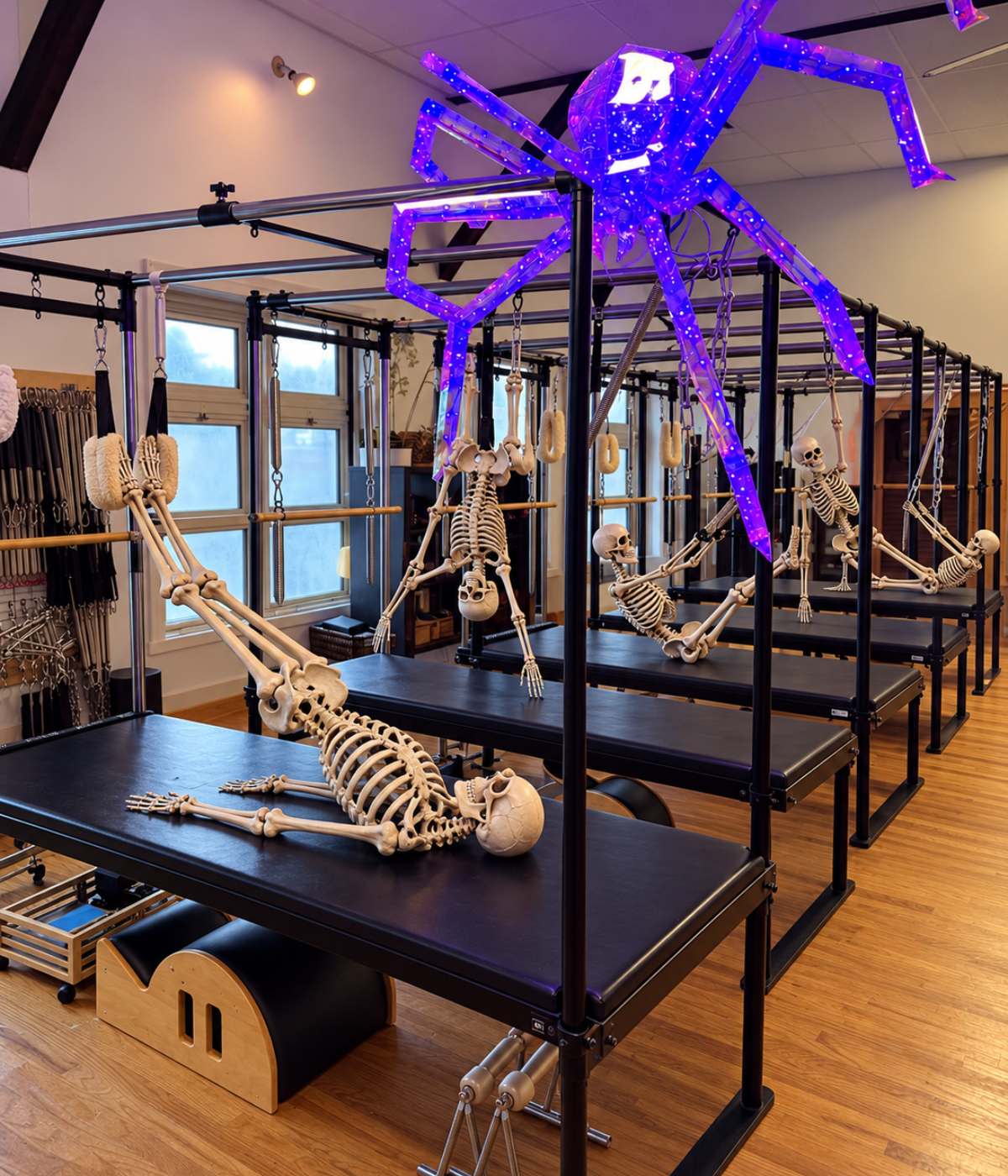
Halloween is the one time of year when skeletons come out of the closet. They hang from porches, dance in front yards, and occasionally show up in Pilates studios. Beneath the costumes, muscles, and skin, our skeletons have some interesting stories to tell. One of those stories involves the anatomical differences between male and female bodies. Although there is considerable overlap between individuals, male and female skeletons differ in several measurable ways. Some of these differences influence how our joints move, how forces travel through the body, and how we experience Pilates exercises.
The Pelvis: More Than Just Wider Hips
The pelvis provides some of the most recognizable differences between male and female skeletons. On average, female pelvises have a wider subpubic angle, a broader pelvic inlet, and a shorter, wider sacrum. These characteristics are associated with the anatomical requirements of childbirth. Male pelvises tend to be taller and narrower, with a more acute subpubic angle. However, external hip width doesn't tell us everything about the underlying skeleton. The shape and orientation of the hip sockets, the angle of the femoral neck, and the rotational alignment of the femur also vary considerably among individuals.
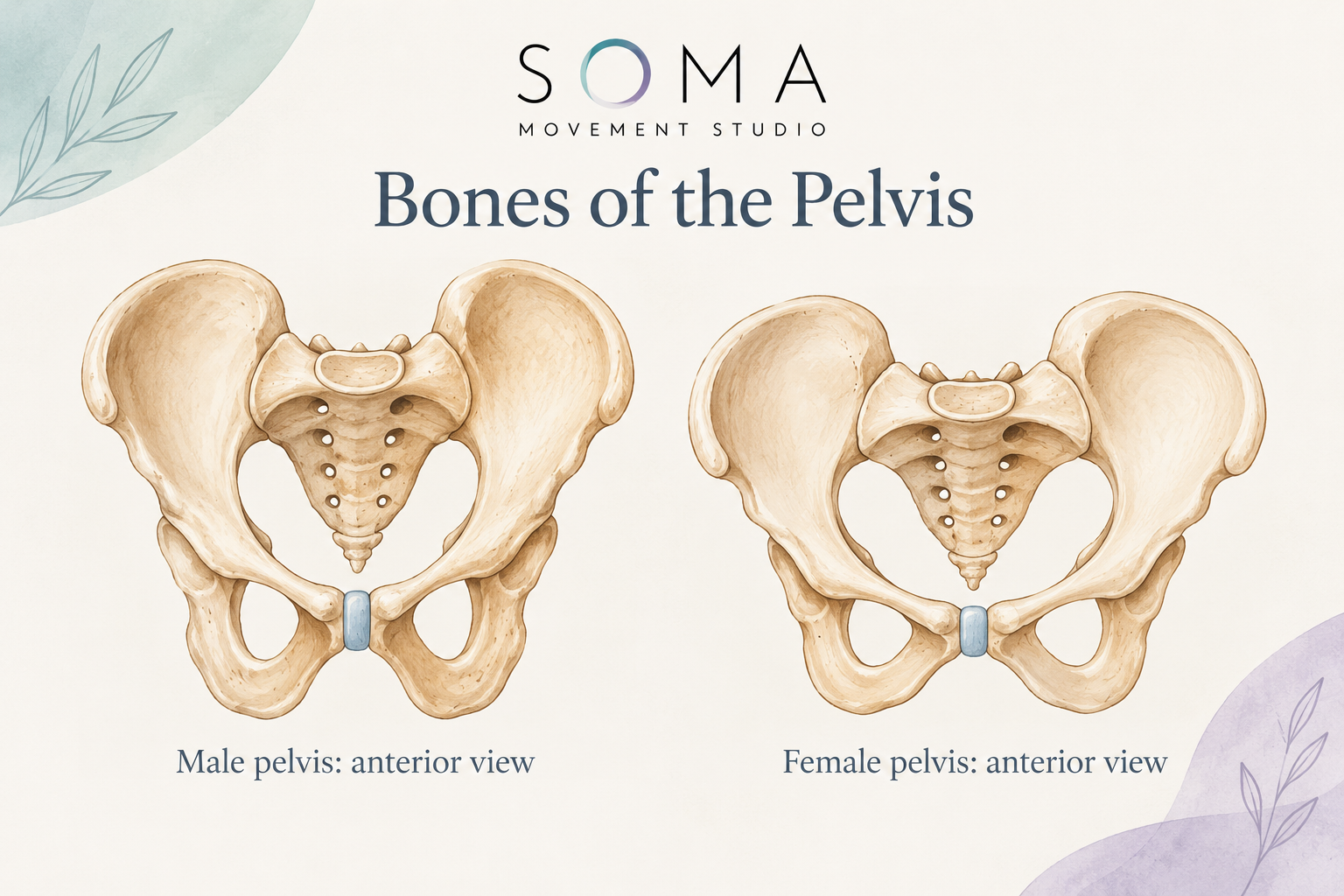
Women generally demonstrate greater hip range of motion than men in several directions, although the differences depend on the movement being measured. Skeletal structure is one contributing factor. The depth, orientation, and coverage of the acetabulum (hip socket) influence how far the femur can move before its neck approaches the rim of the socket. Some anatomical studies have found greater acetabular coverage in male hips, on average, which may contribute to differences in available motion. The rotational orientation of the femoral neck, known as femoral version, also influences movement. Greater femoral anteversion generally favors internal rotation, while reduced anteversion or retroversion tends to favor external rotation.
Another important variation is cam morphology, in which the normally rounded transition between the femoral head and neck is less spherical. Cam morphology is more common in men, particularly those who participated in high-impact sports during adolescence. This shape can reduce clearance within the hip joint during deep flexion and internal rotation, potentially creating earlier contact between the femur and acetabulum. Cam morphology does not necessarily cause pain, but in some individuals it contributes to femoroacetabular impingement syndrome.
These anatomical differences have practical implications for Pilates. During exercises involving turnout, deep hip flexion, or large ranges of leg movement, one client may move comfortably while another encounters resistance much sooner. The limitation may not be caused entirely by tight muscles. Attempting to stretch beyond the available joint clearance will not change the underlying bone structure, and adjusting the position of the legs or the range of movement may be more productive than trying to force a particular shape.
The Q-Angle: Why Knees Don't All Point the Same Way
Another frequently discussed anatomical difference involves the knee. The quadriceps angle, or Q-angle, describes the angle formed by lines connecting the front of the pelvis, the center of the kneecap, and the attachment of the patellar tendon on the tibia. Women, on average, tend to have somewhat larger Q-angles than men, although there is considerable overlap and the measurement varies with technique and body position. Pelvic geometry, femoral alignment, and the relationship between the kneecap and tibia all influence this measurement.
In Pilates, we often cue clients to align their knees with their feet during squats, footwork, and standing exercises. This remains a useful general guideline, but anatomical differences mean that identical-looking positions are not always appropriate for everyone. We need to consider how the hip, knee, ankle, and foot work together rather than assume that one alignment suits every skeleton. A larger Q-angle, by itself, does not indicate a knee problem, and the appearance of someone's leg alignment doesn't necessarily tell us how effectively that person is managing forces during movement.
Bone Size, Proportions, and Strength
Male skeletons are, on average, larger and have greater bone mass than female skeletons. Differences in bone geometry and cross-sectional dimensions also influence how bones respond to mechanical loading. These differences are partly related to body size and hormonal influences during growth and adulthood. Women experience additional changes in bone metabolism with menopause, when declining estrogen levels can accelerate bone loss and increase osteoporosis risk.
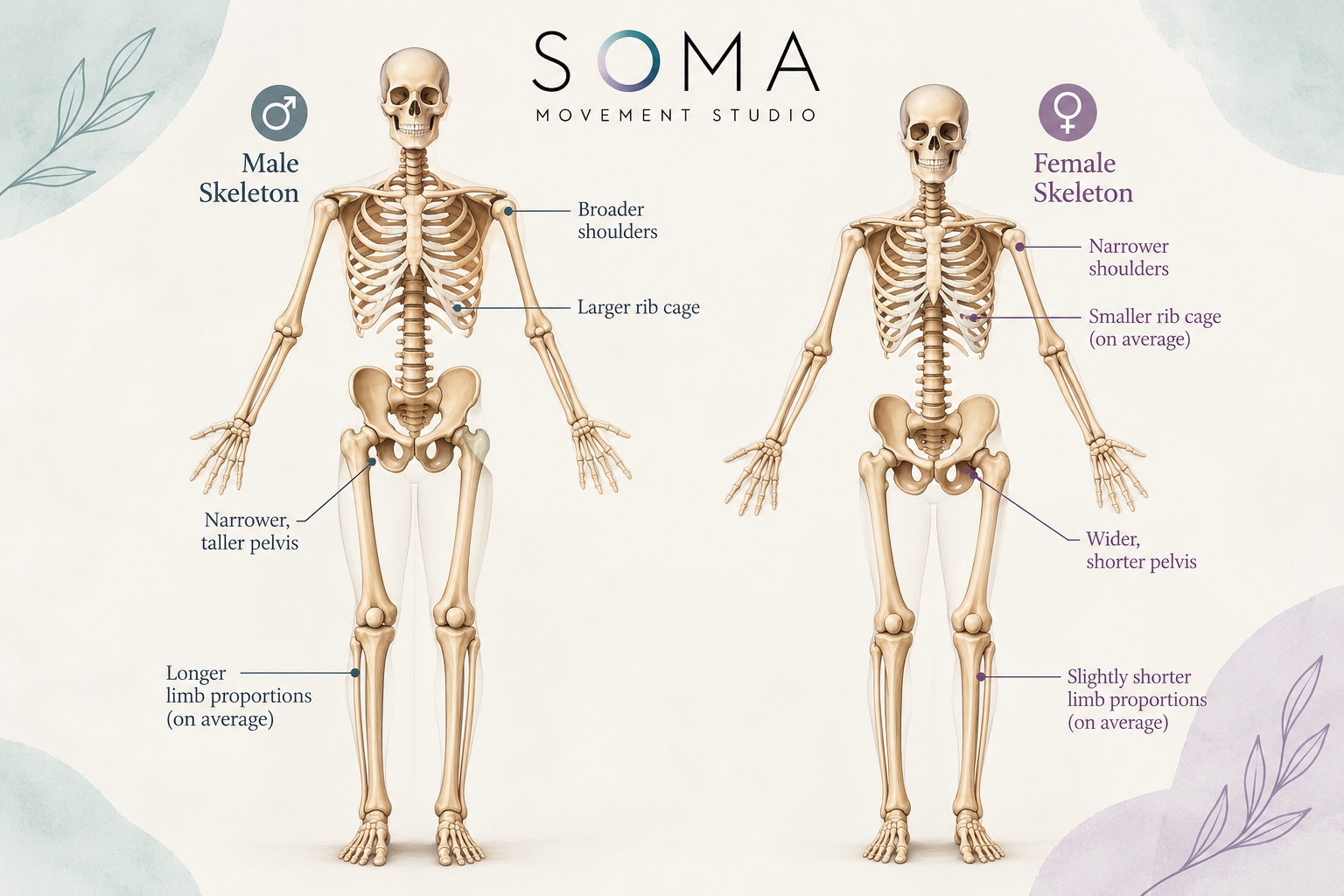
These changes make progressive resistance training particularly important as we age. Pilates can contribute to muscular strength, coordination, and balance, although it should not automatically be considered a substitute for the higher-load resistance and weight-bearing activities often recommended to maintain bone health. Understanding skeletal differences is useful not because it tells us that men and women require completely different exercise programs, but because it reminds us that bone structure and bone health influence the kinds of physical challenges that may be appropriate at different stages of life.
What Does This Mean for Teaching Pilates?
Population averages can help us understand anatomy, but they tell us surprisingly little about the exact shape of an individual client's joints. Some women have narrow pelvises, while some men have relatively wide pelvises. Hip version, spinal curvature, limb proportions, and joint mobility vary within both groups. Two women may have more anatomical differences between them than either has compared with a particular man.
At SOMA, the more useful questions are practical ones. Does the exercise allow the client to move comfortably? Is the intended muscle group being challenged? Does the movement create unnecessary joint stress? Would changing the foot position, range of motion, or resistance make the exercise more effective? These considerations guide individualized instruction far better than assumptions based on sex. The goal isn't to abandon precise technique, but to understand that precision sometimes requires adapting an exercise to the structure and capabilities of the person performing it.
This Halloween, take another look at those skeletons decorating the neighborhood. Their bones might all be molded from the same plastic, but real human skeletons tell a much more complicated story. Male and female skeletal differences are fascinating, particularly in the pelvis and lower limbs, yet the variation among individuals is just as important as the differences between groups. Good Pilates instruction begins with an understanding of anatomy and continues with careful observation of the person in front of us. After all, every body has a skeleton in the closet, and no two are exactly alike.
Happy Halloween from SOMA Movement Studio!
SOMA Movement Studio | Unionville, Connecticut