From Hips to Shoulders: The Hidden Connections That Shape How Your Spine Moves
Have you ever noticed that stretching your hips changes how your lower back feels? Or that tight shoulders seem to affect the way you move your spine? Our bodies don't move as collections of isolated muscles. Every movement involves a coordinated relationship between muscles, joints, connective tissues, and the nervous system. When movement is limited in one area, another part of the body may compensate. Understanding these connections can change how we approach flexibility, strength, and movement.
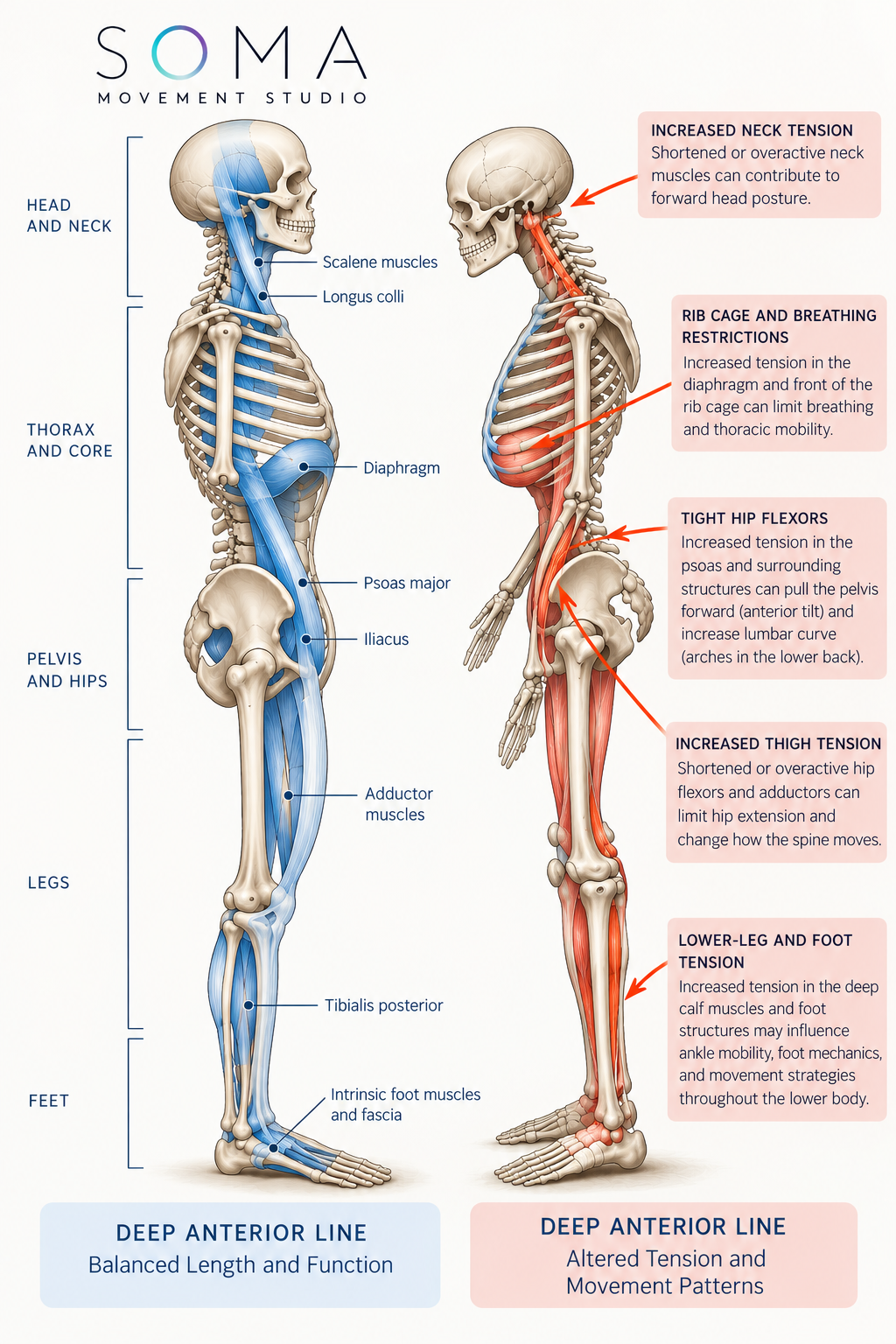
The Deep Front Line: Connecting the Body from Within
In his Anatomy Trains model, Thomas Myers describes a network of interconnected muscles and fascia called the Deep Front Line, sometimes called the deep anterior line. This proposed pathway travels from the inner foot and lower leg, through the inner thighs and pelvis, into the deep muscles of the hips, spine, diaphragm, and neck. One particularly interesting area is where the hips and lumbar spine meet.
The psoas major connects the lumbar spine to the femur, creating a direct anatomical relationship between the lower back and legs. Nearby, the diaphragm attaches to the lower ribs and lumbar spine, linking breathing mechanics with the movement and stabilization of the trunk. These relationships help explain why we can't always address hip stiffness, spinal mobility, or breathing as completely separate issues. The Deep Front Line is a useful framework for exploring these connections, although research has not established that the entire pathway functions as one continuous tension-transmitting structure.
When One Area Doesn't Move, Another Takes Over
Consider what happens when you extend your leg behind you. Ideally, much of that movement comes from the hip joint. But if hip extension is limited, you might compensate by tilting your pelvis forward or arching your lower back. Similarly, limited movement through the upper back can influence how the shoulders move. If the thoracic spine and rib cage don't contribute enough during an overhead reach, the shoulders, neck, or lower back may take on additional work.
These compensations aren't necessarily harmful. Our bodies are remarkably adaptable, but over time, relying on a limited range of movement strategies can make certain activities feel more effortful than they need to. The goal isn't to eliminate compensation. It's to develop more movement options.
Fascia, Tension, and the Freedom to Move
Fascia is connective tissue that surrounds and connects muscles and other structures throughout the body. It helps transmit forces and contributes to how we experience movement. However, feeling tight doesn't always mean a particular muscle or fascial structure has physically shortened. Sometimes the sensation of stiffness reflects muscular effort, habitual movement patterns, or how the nervous system responds to a particular position.
For example, holding your breath or bracing your abdominal muscles can change the way your spine and hips move together. Learning to coordinate breathing, pelvic movement, and spinal motion may allow a previously difficult movement to feel easier. This is one reason stretching alone isn't always the answer.
Mobility Is More Than Flexibility
At SOMA, we distinguish between having a range of motion and being able to use it; passive flexibility vs functional mobility. Someone may have considerable passive flexibility but struggle to control that range during exercise. Another person may feel stiff because they're using more muscular tension than a movement requires. Pilates and somatic movement education help us explore these differences through deliberate, coordinated movement.
Rather than simply trying to stretch farther, we might investigate how the pelvis responds when the leg moves, how the rib cage participates when the arm reaches, or how breathing changes the experience of tension. Sometimes a small change in awareness or coordination creates a surprisingly large difference in how movement feels.
Explore the Connections at Pits & Hips
The hips and shoulders sit at opposite ends of the trunk, but their mobility influences how movement is shared throughout the spine. That's the inspiration behind our upcoming Pits & Hips: Shoulder & Hip Mobility for a Freer Spine workshop.
On Sunday, November 1, from 9:00–10:30 AM, we'll explore how the hips, shoulders, rib cage, and spine work together using Pilates apparatus, breathing, and guided movement. Rather than forcing greater flexibility, we'll focus on developing usable mobility supported by strength, coordination, and awareness.
Whether you feel stiff through your hips, restricted in your shoulders, or simply curious about how your body works, this workshop offers an opportunity to explore those connections firsthand.
Learn more and register for Pits & Hips →
SOMA Movement Studio | Unionville, Connecticut