The Body as a Receiver: How to Tune In
On attention, nervous system regulation, and the result of making room for silence.
Have you ever turned down the music in your car while searching for an unfamiliar address? It is an almost instinctive response. As the streets become less familiar and we concentrate on finding the correct turn, we reach for the volume control. Somehow, turning down the music seems to make it easier to see where we are going.
Of course, the music was never obstructing our vision. It was competing for our attention. By reducing one source of stimulation, we free up some of our brain's limited attentional resources for the task at hand.

We rarely apply this same principle to the way we live. We listen to podcasts while driving, watch television while eating, check our phones while waiting in line, and fill quiet moments with music, news, or conversation. We have become remarkably efficient at eliminating boredom, but perhaps less practiced at noticing what happens when we are no longer occupied.
Our bodies continually communicate information about our internal condition and the environments we inhabit. Muscular tension, breathing patterns, fatigue, physical comfort, and emotional arousal all contribute to our experience of being alive. Yet these signals must compete for our attention with the demands of an increasingly stimulating world. Perhaps the value of silence is not simply that it offers peace, but that it allows us to perceive information we might otherwise overlook.
The Demands of Attention
Our brains are remarkably capable of filtering sensory information, selecting what seems important while processing much of the remaining input outside conscious awareness. Sustained attention, however, requires effort. We can feel exhausted after a day spent sitting at a computer, answering messages, solving problems, and making decisions, despite having done relatively little physical work.
Modern technology extends this occupation into nearly every available moment. The concern is not that podcasts, music, or electronic communication are inherently harmful, but that we have gradually eliminated many of the intervals in which our attention might otherwise be free to wander.
Environmental psychologist Stephen Kaplan explored the restorative potential of natural environments in his 1995 paper, The Restorative Benefits of Nature. His Attention Restoration Theory proposes that certain environments engage us through soft fascination, a gentle form of attention that requires relatively little deliberate concentration. Watching clouds move, listening to leaves rustle, or observing sunlight filtering through trees can hold our interest without continually demanding decisions.
My favorite example is mushroom foraging. Each new mushroom produces a little burst of excitement, not unlike discovering something interesting while scrolling, but without the screen. The experience is engaging without requiring me to respond to a notification, accomplish a task, or satisfy someone else's expectations. Rest, in this sense, is not necessarily the absence of stimulation. Sometimes it is the absence of demands.
The Physiology of Engagement and Recovery
Our autonomic nervous system coordinates many of the physiological adjustments that allow us to interact with the world, influencing heart rate, digestion, vascular function, and other processes operating largely outside conscious control.
I sometimes explain the relationship between its sympathetic and parasympathetic divisions using the analogy of driving a car. The sympathetic nervous system helps mobilize us for activity, much like pressing the accelerator. It supports alertness, energy, and readiness when we exercise, concentrate, or respond to challenges. Sympathetic activation is not inherently negative; we depend upon it to participate fully in life.

The parasympathetic nervous system contributes to recovery, digestion, and the regulation of physiological activity. Within our analogy, it helps us ease off the accelerator and adjust to changing conditions. The two systems are not simply opposing switches, however, and both participate in normal functioning, often simultaneously. Effective regulation is less about remaining permanently calm than about responding appropriately to the demands of the moment.
Acceleration is useful when entering a highway, but maintaining that intensity through a quiet residential neighborhood would be inappropriate. Our nervous systems face a similar challenge. We need the capacity for activation, but we also need opportunities for recovery.
Neuroscientist Bruce McEwen explored this relationship through the concepts of allostasis and allostatic load. Allostasis describes how the body maintains stability through physiological adjustments, while allostatic load refers to the cumulative burden associated with repeated or prolonged activation of these adaptive systems. Persistent stress can influence sleep, mood, concentration, digestion, and muscular tension. More subtly, we may become so accustomed to operating under constant demands that we fail to recognize how fatigued we have become. Exhaustion may be mistaken for poor motivation, while difficulty concentrating becomes another reason to push harder.
Resilience is not simply the ability to tolerate increasing demands. It also involves recognizing when those demands have changed and adjusting our responses accordingly.
Interoception and the Ability to Know Ourselves
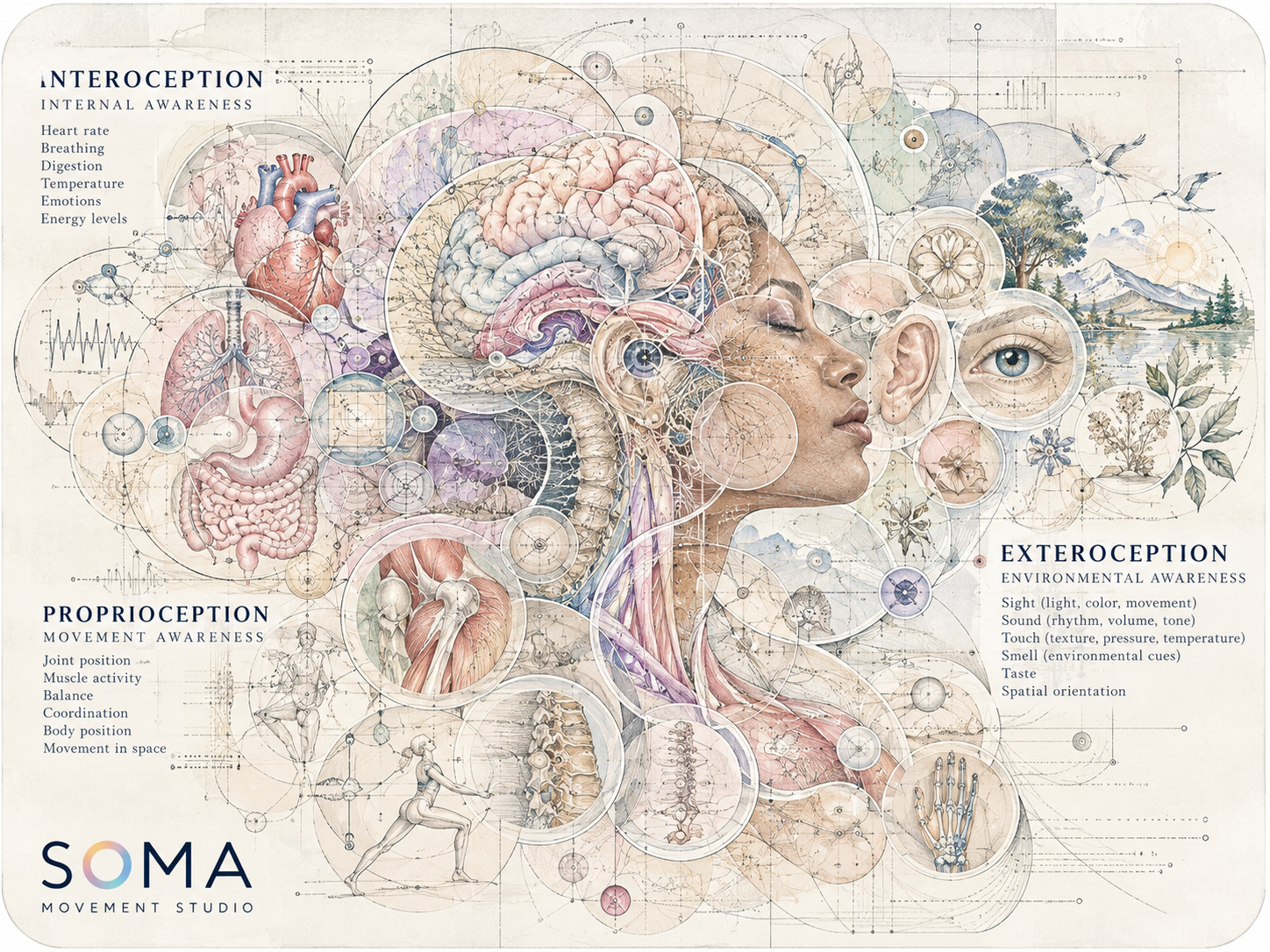
We are familiar with sight, hearing, touch, taste, and smell, but sensory awareness extends beyond these traditional categories. Exteroception involves sensing the external environment, proprioception helps us perceive the position and movement of our bodies, and interoception encompasses the sensing and interpretation of information arising from within the body.
Interoception includes signals associated with heartbeat, breathing, hunger, temperature, and other physiological conditions. In their 2018 review, Interoception and Mental Health: A Roadmap, neuroscientist Sahib Khalsa and colleagues described how the nervous system senses, interprets, and integrates information about the body's internal condition, contributing to both physiological regulation and emotional experience.
This process is more complicated than simply receiving a message from the body. The brain interprets sensations through the influence of memory, expectation, emotion, and context. A rapid heartbeat might accompany excitement, anxiety, exercise, or anticipation. Muscular tension might reflect physical effort, psychological stress, or prolonged positioning.
Consequently, greater awareness does not automatically mean greater understanding. Learning to recognize bodily sensations also requires learning to interpret them thoughtfully, without assuming that every sensation has a single explanation. Constantly monitoring ourselves can become counterproductive, particularly when it increases anxiety. The objective is a flexible awareness that allows us to recognize meaningful changes without becoming preoccupied with them.
Periods of reduced external stimulation may make internal sensations more noticeable. Fatigue overlooked during a busy afternoon can become apparent when we finally sit quietly. Tension in the shoulders may become recognizable when our attention is no longer absorbed elsewhere. The sensations were not necessarily absent before; our attention was simply directed toward something else.
Movement as Sensory Education
This relationship between sensation, attention, and response is central to mindful movement practices, including Pilates. Although Pilates is frequently described in terms of strength, flexibility, and posture, an important aspect of the method is developing a more refined awareness of movement.
Consider someone performing an exercise intended to occur primarily at the hip who unknowingly compensates through the lumbar spine. With appropriate instruction and sensory feedback, that person may begin to distinguish movement at one joint from movement occurring elsewhere. Similarly, learning to recognize weight distribution through the feet, the relationship between breathing and trunk movement, or the amount of muscular effort required for a task can contribute to improved coordination.
The objective is not to consciously control every movement. Skilled movement depends heavily upon automatic processes, and excessive attention to mechanics can sometimes interfere with performance. Rather, sensory education develops our ability to notice relevant information when necessary and integrate it into more effective movement patterns.
This awareness also has relevance beyond the studio. Recognizing muscular effort, fatigue, balance, and breathing can inform how we walk, garden, lift objects, and respond to physical challenges. It may also help us distinguish between useful effort and unnecessary tension, or between an appropriate challenge and excessive strain.
At SOMA, even familiar Reformer footwork can become an opportunity for this kind of observation. How does the movement feel today compared with last Tuesday? Has something changed in your coordination, your energy, or your ability to concentrate? These observations need not become judgments about performance. They are simply information. Movement becomes not only something we do with our bodies, but a means of learning from them.
Rediscovering the Value of Silence
There is something quietly profound about recognizing that our bodies are not separate from the natural world but are expressions of it. Our physiology responds to gravity, temperature, light, and the composition of the atmosphere. Our biological rhythms are influenced by the rotation of the Earth, while our sensory systems continually gather information about the places we inhabit.
We often speak of going into nature as though we are entering a world distinct from our ordinary existence. Yet this relationship is a fundamental condition of being alive. What changes during a walk through the forest, a quiet moment beside a lake, or perhaps a particularly attentive Pilates lesson is our awareness of that relationship.
We have become accustomed to thinking that unoccupied time is wasted time, that boredom represents a problem to be solved, and that rest must be justified by the productivity it makes possible afterward. Yet not every moment needs to serve a measurable purpose. Some experiences are valuable because they allow us to become more aware of our own existence.
Silence does not always produce immediate calm. Sometimes it reveals fatigue, discomfort, or a need for change. The purpose of tuning in is not to withdraw from the world or eliminate the stimulation that makes life interesting. It is to cultivate a more flexible relationship with attention, allowing us to engage fully when circumstances require it and recognize when we need to recover.
Just as we instinctively turn down the music when searching for an unfamiliar destination, we can learn to reduce competing stimulation when we need to perceive something more clearly. Sometimes what we are searching for is not an address or a landmark, but a better understanding of our own condition. Sometimes the information we need has been available all along, waiting for enough quiet to enter our awareness.
References & Further Reading
Kaplan, S. (1995). The restorative benefits of nature: Toward an integrative framework. Journal of Environmental Psychology, 15(3), 169–182. https://doi.org/10.1016/0272-4944(95)90001-2
McEwen, B. S. (1998). Stress, adaptation, and disease: Allostasis and allostatic load. Annals of the New York Academy of Sciences, 840, 33–44. https://doi.org/10.1111/j.1749-6632.1998.tb09546.x
Khalsa, S. S., et al. (2018). Interoception and mental health: A roadmap. Biological Psychiatry: Cognitive Neuroscience and Neuroimaging, 3(6), 501–513. https://doi.org/10.1016/j.bpsc.2017.12.004